History
Section 163: what the real law says, and how the game's cordon works

Sandeep Sahu
· 7 min read
Every route in Chalo Jantar Mantar ends at a red ring on the road and a board that says "SECTION 163 CORDON · PERMISSION DIKHAO". Here is a short, plain look at the real Section 163 and why it comes up at Jantar Mantar, and then exactly how the game's own cordon works: what happens at 30 people, what happens at 100, and how the barricades and the dharna fit in.
Section 163 in real life
For decades, when people in India said "Section 144 laga hai", they meant Section 144 of the Code of Criminal Procedure, 1973. On 1 July 2024 that code was replaced by the Bharatiya Nagarik Suraksha Sanhita, 2023 (BNSS), and the same power now sits in its Section 163. Many people still call it Section 144 out of habit.
Section 163 lets a District Magistrate, or another executive magistrate empowered to do so, issue an order in urgent cases of nuisance or apprehended danger: when something has to be done quickly to prevent, for example, danger to people's life or safety, or a disturbance of public peace. In practice such orders are often used to stop people gathering in a particular area for a limited time.
That is all the law this page needs. I make games, and this is a plain summary, not legal advice: if you need to know what a real order says, read the order itself or ask a lawyer.
Why it comes up at Jantar Mantar
The road beside Jantar Mantar in New Delhi, a short walk from Parliament, has been the city's best-known place to protest for decades. It has also been argued over. In 2018 the Supreme Court said that a blanket ban on protests there was not right, and asked the authorities to frame rules so that protests could go on in a regulated way. I wrote more about the observatory and how its road became a place to be heard in the history of Jantar Mantar.
A place to be heard, and a place where gatherings are regulated: that pairing is the idea behind the game's cordon. The game takes no side on it, and it makes no claim about any real order at any real place.
The game's cordon: a simple, satirical rule
In the game I turned that idea into a rule with two layers round Jantar Mantar. It is a game rule, simplified and played for laughs. The numbers in it, 30 and 100, are game numbers, set for the game and not taken from any real order. The police who enforce it are a made-up cartoon force.
Both layers count the same thing: your crowd. That is you, plus every andolankari leader standing near you, plus all of their kafilas. So two leaders with 60 each, walking together, are a crowd of 122. When your crowd is bigger than your own kafila, the card at the top left shows both, like "Kafila 0 (crowd 133)".
Layer 1: the red ring and "Permission dikhao!"
The outer layer is a dashed red ring painted on the ground round Jantar Mantar, also drawn on the Dilli map, with a red board wherever a road crosses it. The metro stations, the chai stalls and the points where autos drop their riders are all outside it.
Cross into the ring with a crowd of fewer than 30 and the police stop you: an officer nearby calls out "Permission dikhao!", the feed says "🛑 Section 163! … stopped at the cordon — "Permission dikhao!" FIR +1", and a star goes on your FIR. While you stay inside the ring under 30, a warning stays on your screen: "🛑 SECTION 163 CORDON — groups under 30 get stopped".
The stop is a telling-off, not a wall: you can keep walking. What it costs you is that FIR star, and stars matter, because the police bots choose whom to chase partly by them. The check happens each time you cross in, so walking in and out of the ring with a small group collects a star every time. A star fades 40 seconds after your last new one, then one more every 40 seconds.
Layer 2: the taped zone and the 100 rule
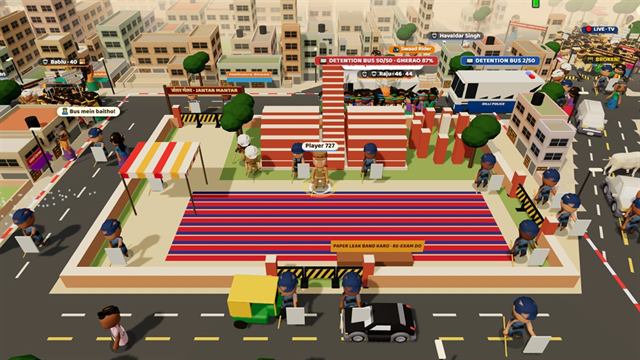
The inner layer is the Section 163 zone: the observatory compound and the roads round it, marked with red-and-white tape on the ground and a solid red line on the map. Boards beside the barricades on the roads leading in say "SECTION 163 ZONE · 100+ LOG CHAHIYE".
As you come near the tape, the game tells you where you stand: "⚠ SECTION 163 ZONE ahead — 100+ people needed (you have 64). Fewer = instant detention!", or, with enough, "✅ Crowd 112 — big enough to enter the Section 163 zone". Inside it keeps reminding you: "Don't drop below 100!".
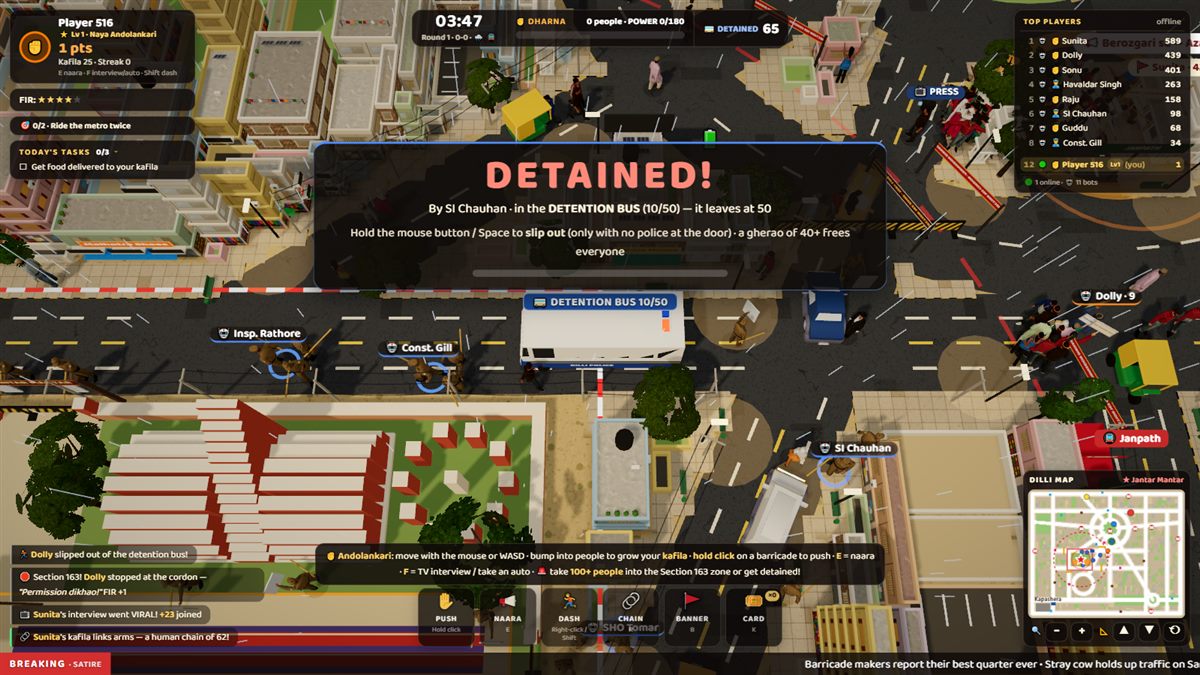
That reminder matters, because the rule is checked all the time you are inside, not just at the tape. The moment your crowd is under 100, "🚨 SECURITY GRABBED YOU!": you are held for up to six seconds while two security jawans run over, lift you and carry you to the detention bus. Your whole kafila leaves you when you are lifted, and about half of it goes to the bus with you.
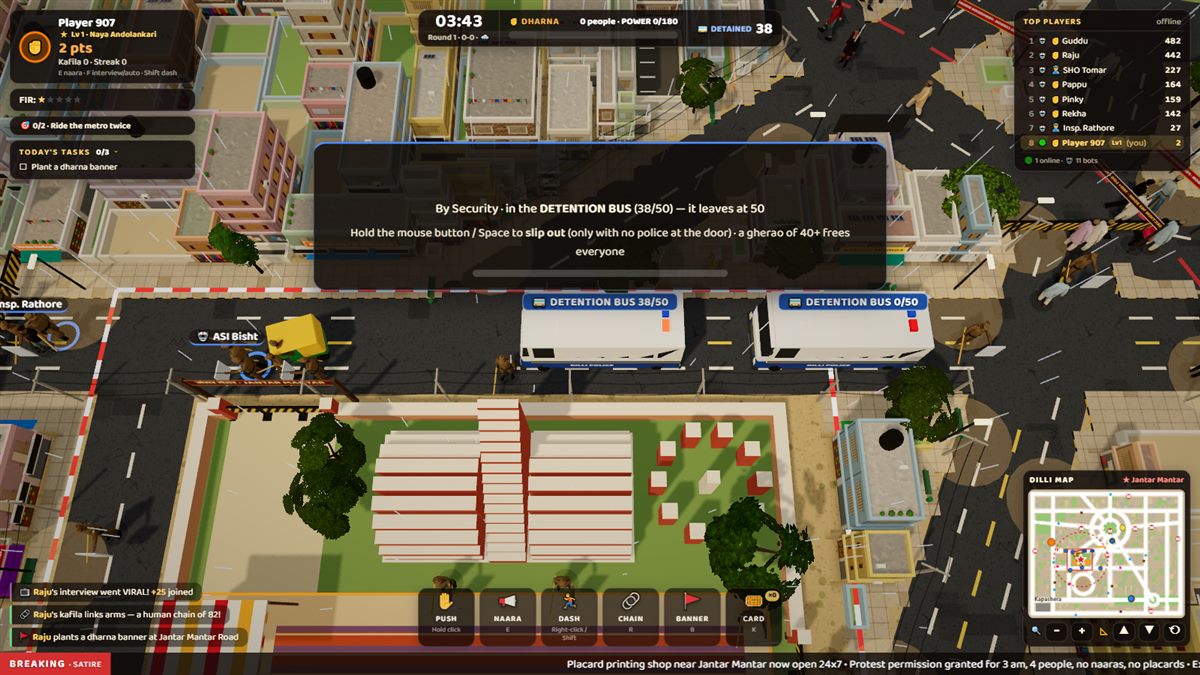
A few more things live inside the zone. Security jawans stand at fixed posts: in front of each gate, round the dharna ground and on the roads leading in. Every few seconds each one swings a lathi at the nearest kafila member within reach, and that person is gone from your kafila. Near the zone the game always shows each leader's real kafila size over their head, because a phone draws only part of other people's kafilas and a crowd can look smaller than it is. And anyone just let out of a detention bus gets 8 seconds before security looks at them again, which is not long, since the buses stand inside the zone.
Barricades, gates and the dharna
Seven police barricades guard the way in: one in each of the observatory's three gates (north, south and east), and four across the roads at Sansad Marg, Jantar Mantar Road, Ashoka Road and Tolstoy Marg. Protesters and passers-by can't walk through them; the police walk straight through.
To push one, stand against it and hold the mouse button (the ✋ PUSH button on a phone). A barricade has 100 strength, and you take away 9 a second plus 2.5 for every one of your kafila close to it. Alone that is more than ten seconds; with 40 of your people pressed behind you it falls in under one. Stop pushing and it slowly recovers. When it breaks, "🚧 Police barricade broken at …!", and you get 50 points, a step on your streak and an FIR star. It stays down for at least 20 seconds and stands up again once nobody is in the way. A police press briefing in front of a TV crew brings broken barricades back up sooner.
The dharna ground, orange on the map and marked "⬇ DHARNA · SIT HERE", is inside the compound, so inside the zone. To score there you need your 100 the whole time, and you have to get through a gate. Every second you are on the dharna ground adds to the POWER bar, more for each of your kafila sitting there with you, a little more in the evening, and a little more with your banner planted there. Fill the bar and the round is yours.
Playing the cordon from both sides
For the andolankari:
- Grow outside the red ring, where the chai stalls and metro stations are, and cross it with 30 or more.
- Meet your friends before the tape. Kafilas add up, so walk in together rather than one by one.
- Watch the number on your card inside the zone. A lathi or a tear gas cloud that takes ten people from a crowd of 105 is enough for security.
- Push a gate barricade with your kafila pressed behind you, never alone.
For the police:
- Inside the tape the rule does half your work. You don't have to detain a crowd of 110, only take it below 100, and security does the rest.
- When barricades are down, find a TV crew and give a press briefing.
- Small groups crossing the red ring collect FIR stars; the leaders with the most stars are worth watching.
- The police side of the special Jan Sailab Jugaad card is a "Section 163 order" of its own: protesters near you slow down for 10 seconds. The Jugaad cards guide has the details.
For the bigger picture of each side's game, read the andolankari tips and the Dilli Police strategy guide.