Devlog
Festivals in the game: Dussehra's Ravan dahan, the Diwali week and Holi colours
Sandeep Sahu
· 7 min read
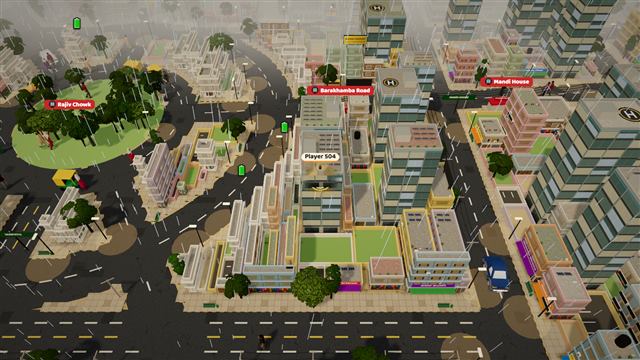
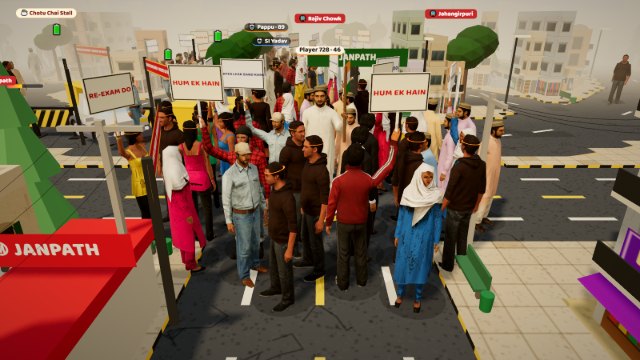
Chalo Jantar Mantar is played on the roads of New Delhi, and in a festival week those roads look different: Ravan stands in the park at Dussehra, the roofs are lit at Diwali, the ground turns to colour at Holi, and the tricolour goes up in August and January. So the city in the game changes too. Here is what each festival brings, when it comes, and what you can earn.
Why the city celebrates
The game is a satire about protests and the police, but the city it happens in is a real one, and festivals are part of its streets. So I dress the city up for them. It is still a satire game, so the news ticker gets festival headlines of its own, but the decorations are made to look like the real thing. They don't change how a match is played; the rewards that come with some festivals are extra.
How the game knows the date
There is a small calendar in the game's code with each festival's date for the next few years. The decorations go by the date in India, so a player abroad sees Diwali on India's day. The double XP, the Diwali kurta and the festival cards go by the server's clock instead, so setting a phone to another date doesn't open them early. Each festival has its own window:
- Dussehra: from a week before Vijayadashami until the day itself.
- Diwali: from three days before Lakshmi Puja to two days after.
- Holi: from two days before the day of colours to one day after.
- The tricolour: 13 to 16 August and 24 to 27 January, around Independence Day and Republic Day.
On those days the menu has a festival line with an EVENT badge, and the quick phrases (💬 on a phone, keys 1 to 7 on a computer) get an eighth one on key 8: "Happy Dussehra!", "Happy Diwali!", "Holi hai!" or "Jai Hind!".
Dussehra: Ravan in Central Park
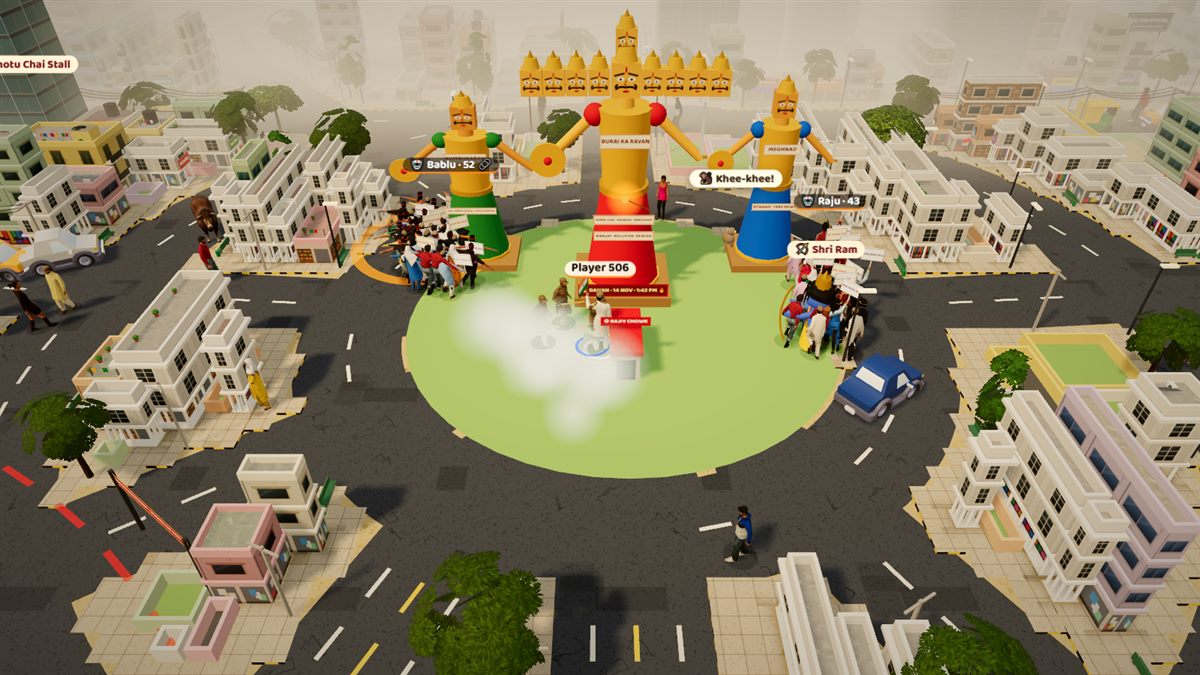
I built the Dussehra effigies in October 2026, two days before Dussehra. For the week before Vijayadashami, three tall effigies stand on the grass of Central Park in Connaught Place: Ravan with his ten heads in the middle, and Kumbhkaran and Meghnad on either side. Besides its name, each one carries some of the city's everyday evils:
- Ravan is "Burai ka Ravan": paper leak, mehngai, berozgari, rishwat, pollution and re-exam.
- Meghnad is afwaah and fake news.
- Kumbhkaran is laal feeta-shahi and the sota daftar: red tape, and the office that sleeps.
A board under Ravan gives the date and time of the dahan, and all week the news ticker starts with it. The ticker also gets Dussehra headlines, such as "All ten of Ravan's heads apply for the same peon vacancy".
The Ravan dahan
On Vijayadashami, at 6:30 pm India time, the dahan begins the way it does at a Ramlila. It runs by the clock, so everyone playing sees it at the same moment. If you are in a match, the game reminds you ten minutes before, and again one minute before.
- A conch and the dhol open it, and Shri Ram walks in with his bow.
- He lights the effigies with flaming arrows, one by one: Kumbhkaran first, then Meghnad, and Ravan last, about a minute after the start.
- Each effigy catches fire, its heads burst with crackers, and it blackens and topples.
- When Ravan falls, crackers fill the sky over the park. Shri Ram blesses everyone, the game wishes you "Shri Ram's blessings. Happy Dussehra!", and he leaves.
- The embers smoulder a little longer, and about seven minutes after the start the park is empty again.
You don't have to be in Central Park to see it. While the dahan is on, a small LIVE window in a corner of the screen shows the park wherever you are in the city, and one tap closes it. It is only there to watch: the match goes on around it, and nobody wins or loses anything by watching. In late October, when the game got its 3D look, Shri Ram got a 3D model too. You will see him at the next dahan, on 9 October 2027.
The Diwali week
Diwali 2026 fell on 8 November, so the city was lit from 5 to 10 November. Strings of coloured bulbs ran along the roof edges of most buildings and between the street lamps, in two sets that take turns to shine and glow brighter after dark. A pair of clay diyas burned at the foot of every street lamp, with a line of them round the dharna zone, and at night fireworks burst over the city, each with a soft boom.
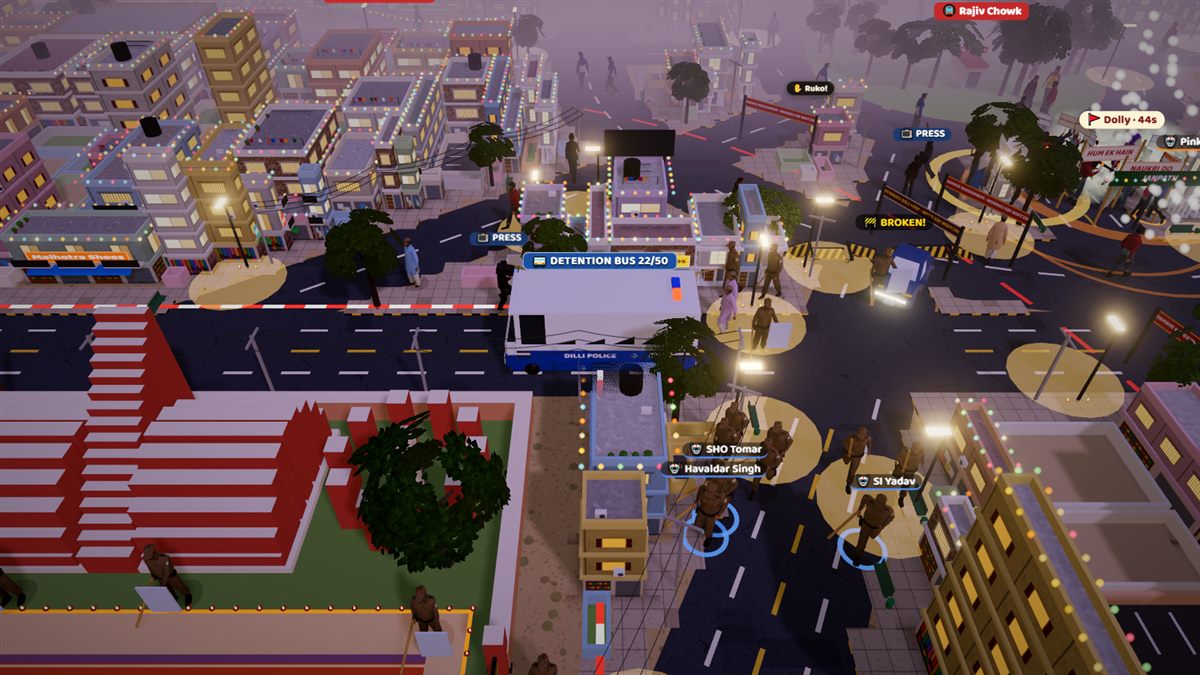
The ticker had its own headlines, such as "AQI also celebrates Diwali, lights up at 999" and "Police barricade gets a toran; 'it is still a barricade', clarifies SHO". And the week came with rewards:
- Double XP on every match, online and practice.
- The Diwali kurta and a lit 🪔 diya to carry, for finishing just one match in the week. They opened in 👕 Look and are kept for good; after 10 November they could no longer be earned.
- 🌟 Diwali Dhamaka, a golden Jan Sailab card, for everyone who opened the game from 8 to 10 November. For andolankari it brings 15 people into the kafila at once; for the police it is Dhara 163, which slows everyone nearby for 10 seconds. Like every card, it stays until you play it.
- The Diwali ke Neta badge for the week's top 3 on either side of the leaderboard.
More on the cards is in the Jugaad cards guide, and on XP and looks in levels and rewards.
A Diwali greeting with your own character
In the Diwali week the festival line on the menu turned into a button: "Happy Diwali! Send your wishes to friends 📲". Tapping it made a square picture: शुभ दीपावली at the top, your own character standing on a lit spot (or your side's emblem), "Aapko aur aapke parivaar ko Diwali ki dher saari shubhkamnayein!" with your name under it, and a row of diyas. If you hadn't typed a name yet, the game asked for one first, because the card says who it is from. On a phone it went out through the share sheet; on a computer you could send it to WhatsApp, Facebook, X or Telegram, or download it. It is a greeting first: the game's name sits in a strip at the bottom.
Holi colours
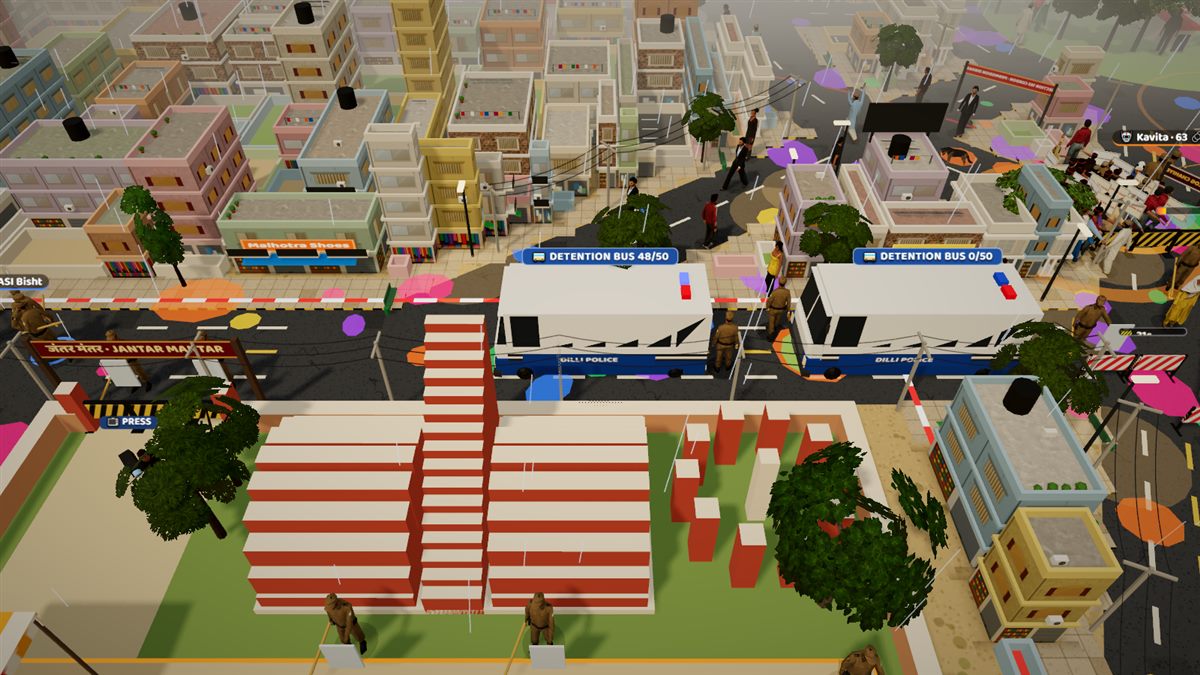
Holi hasn't come round in the game yet. The next one is on 22 March 2027, and the colours will be out from 20 to 23 March. The roads and footpaths will be splashed with pink, green, yellow, blue, purple and orange gulal. Every naara will throw a puff of colour into the air, a new person joining a kafila will sometimes bring a smaller puff, and the menu will say "Happy Holi! Bura na mano, andolan hai!". On Holi and the day after, everyone who opens the game gets a 🎨 Holi Hungama card.
The tricolour, and what comes next
Around 15 August and 26 January the city puts up saffron, white and green bunting, on strings between the street lamps and along many roofs. The national flag itself flies only from the flagpole at Parliament. On 15–16 August and 26–27 January everyone gets a card too: 🇮🇳 Azadi Josh or 🇮🇳 Gantantra Josh.
These are the next dates already in the game's calendar:
- 24–27 January 2027: the tricolour, with Gantantra Josh on 26–27 January.
- 20–23 March 2027: Holi colours, with Holi Hungama on 22–23 March.
- 13–16 August 2027: the tricolour, with Azadi Josh on 15–16 August.
- 2–9 October 2027: Ravan, Meghnad and Kumbhkaran in Central Park, with the dahan on 9 October at 6:30 pm and a 🏹 Dussehra Vijay card on 9–10 October.
- 26–31 October 2027: the Diwali lights, with Diwali Dhamaka on 29–31 October.
The calendar already holds Holi, Dussehra and Diwali for 2028 as well. How the rest of the city was made is in how I built the game.